
The Colosseum in Rome: How to Buy Tickets, Get into the Underground, and Avoid the Queues
The celebrations on the occasion of the opening...
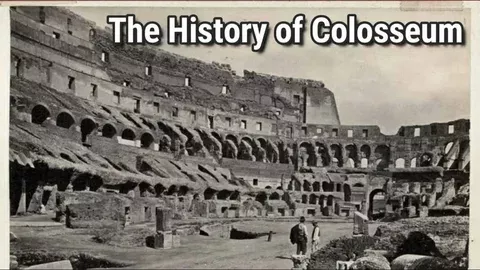
History and Architecture of a Colossus
The Roman Colosseum, or Flavian Amphitheatre, is not merely ruins but a brilliantly engineered machine for spectacles. Its construction began around 70-72 AD by decree of Emperor Vespasian on the site of a drained lake in the park of Nero's Golden House (Domus Aurea), a symbolic act of returning land to the people. It was financed with spoils from the Jewish War. The colossal project was completed in 80 AD by Vespasian's son, Titus, who inaugurated it with one hundred days of games. The name "Colosseum" became established later, likely due to its proximity to the "Colossus of Nero" — a giant bronze statue.
The amphitheatre's architecture was revolutionary. The elliptical travertine structure (188x156 m) rose 50 meters and featured three tiers of arches adorned with columns of the three classical orders: Doric, Ionic, and Corinthian. The fourth, upper tier was solid, with brackets for the unique velarium system — a giant canvas awning operated by 240 sailors of the imperial fleet to shade spectators from sun or rain. A genius system of 80 entrance arches (vomitoria) allowed 50,000 spectators (maximum — up to 68,000) to fill or empty the tiers in mere minutes, a concept still relevant for modern stadiums.
Seating capacity and distribution strictly reflected social hierarchy. The imperial box (pulvinar) was located by the arena, followed by seating for the Vestal Virgins, senators, and equestrians. Higher up were Roman citizens, and on the very top tiers — the plebeians, women, and slaves. Each marble seat was numbered.
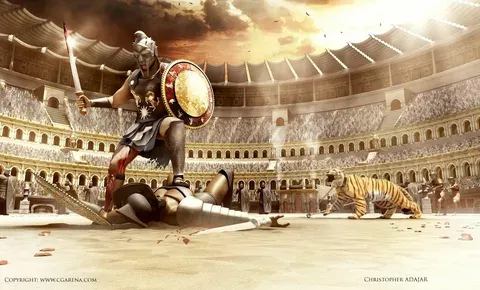
The Underground World and Bloody Spectacles
The heart of the Colosseum was not the visible arena, but the two-level hypogeum hidden beneath it — a complex underground network. Here were cages for predatory beasts (lions, leopards, elephants) brought from Africa, barracks for gladiators, storage for props, and 36 mechanical elevators with winches. This system could instantly raise scenery, trees, or wild animals to the surface, astonishing the crowd. It was here that the main spectacles (ludi) were prepared: gladiatorial combats (munera) and wild animal hunts (venationes).
Gladiators were not only slaves and prisoners of war but also free citizens who took the gladiator's oath (sacramentum gladiatorum), becoming legally "dead," in pursuit of fame and money. Their fights, initially possessing a ritual character as a sacrifice to Mars, became a tool of political propaganda. Beyond this, the amphitheatre was used for public executions and grand naumachiae — naval battle re-enactments for which the hypogeum was flooded via a complex hydraulic system. The peak was Emperor Trajan's festival in 107 AD, which lasted 123 days with the participation of 10,000 gladiators.
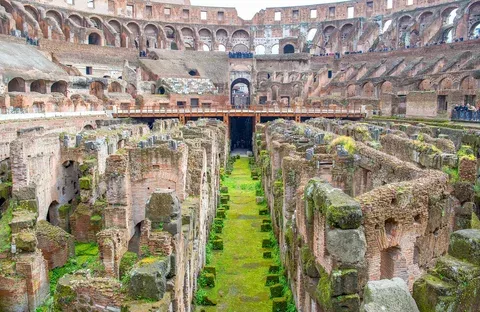
Modernity and Practical Information for Your Visit
Today, the Colosseum is Italy's most visited archaeological site, a UNESCO World Heritage Site, and a must-see in Rome. It is located in the historic centre, in the valley between the Palatine, Esquiline, and Caelian Hills, at Piazza del Colosseo, 1. The easiest way to get there is by metro (Line B) to "Colosseo" station, which offers the famous view of the amphitheatre.
Opening hours vary by season; check them on the official website. The standard ticket (€16 in 2024) includes access to the Roman Forum and Palatine Hill and is valid for 48 hours. However, to truly immerse yourself in history, we recommend booking a thematic guided tour. Prices vary:
-
Tour with access to the Arena and Underground (Hypogeum): from €80-100. Allows you to walk through the Gladiators' Gate and see the elevator mechanisms.
-
Group tour with "Skip-the-Line" access: from €40-60. Includes the Colosseum, Forum, and Palatine Hill.
-
Combo tour "Colosseum + Vatican": from €120. Ideal for those wanting to save time.
Top tip: Purchase tickets online in advance via the official site or trusted aggregators. This will save you from hours-long queues at the ticket office, especially during peak season (April-October). The weather in Rome is hot at this time, so ensure you have water and a hat. Access to the hypogeum and arena is only available as part of organized tours; book spots several weeks in advance.
The Colosseum survived earthquakes (the strongest in 1349), centuries of neglect when it served as a quarry for Roman palaces. But, as the monk Bede the Venerable predicted, as long as it stands, so does the Eternal City, inviting everyone to touch its grand history.