
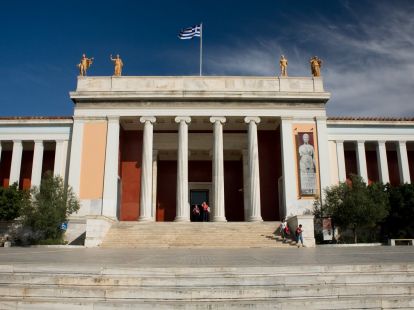
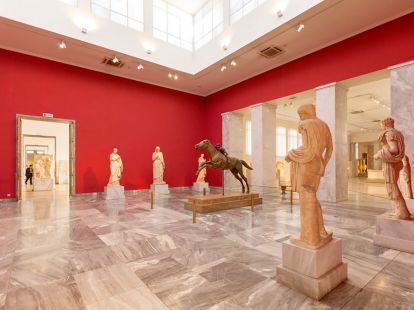
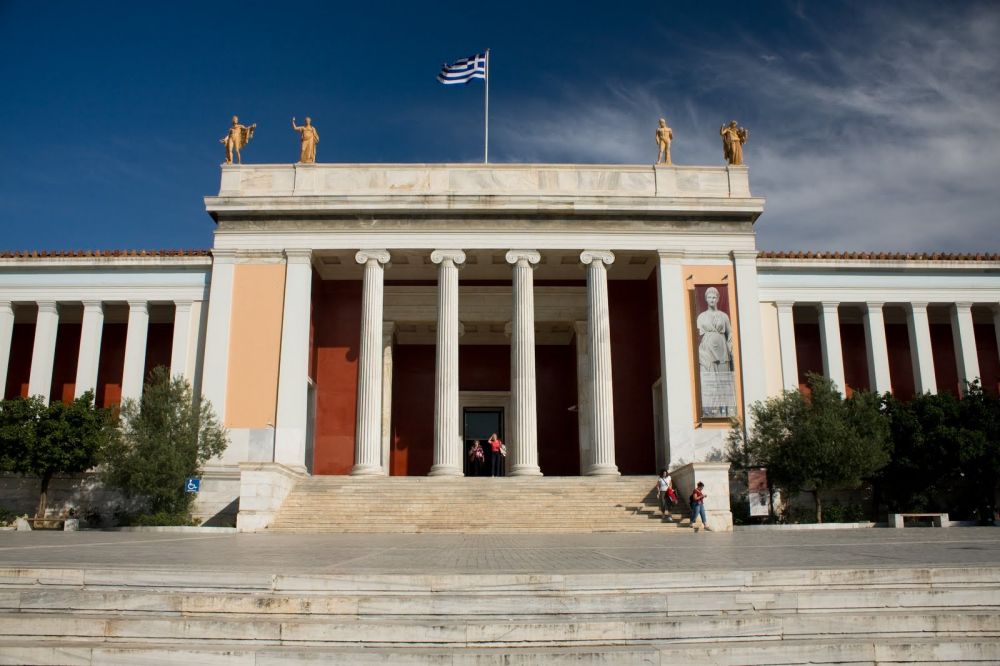
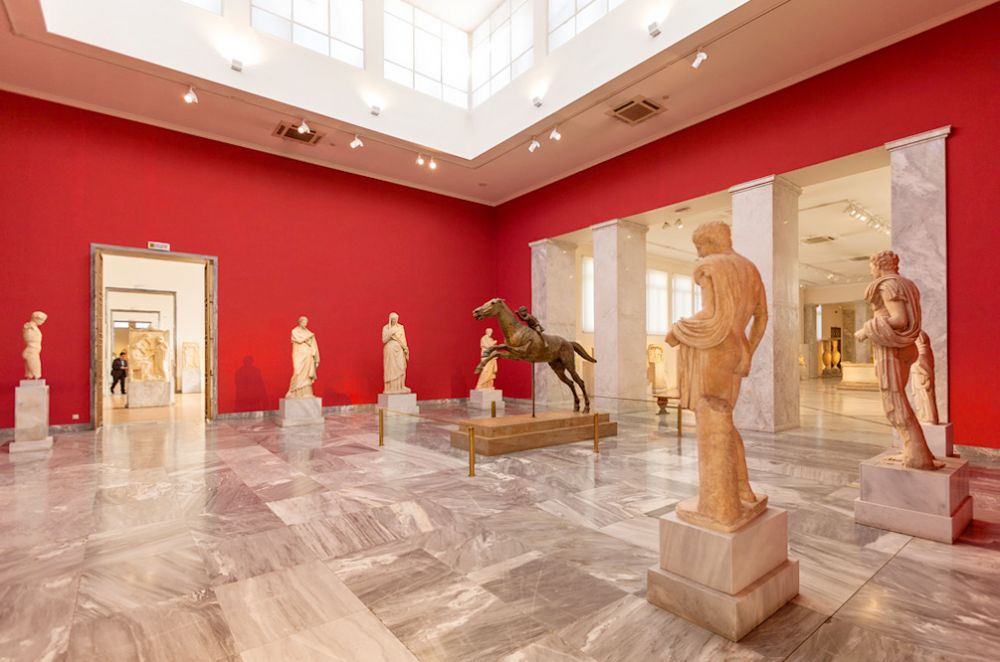
National Archaeological Museum of Athens – the largest museum in Greece and one of the most comprehensive collections of ancient Greek art in the world. Located in the center of Athens at 44 Patision Street. The collection numbers over 20,000 exhibits, covering the period from the 7th millennium BC to the 5th century AD. For tourists, history lovers, families with children, and anyone who wants to touch the cradle of Western civilization.
Masterpieces of the Exhibition
The Golden Mask of Agamemnon – a burial mask made of pure gold, discovered by Heinrich Schliemann at Mycenae in 1876. Dating from 1600 BC, made of thick sheet gold using the repoussé technique. Statue of Poseidon from Cape Artemisium – a bronze original from the 5th century BC, 2.09 m high, raised from the bottom of the Aegean Sea off Cape Artemisium on the island of Euboea in 1928. The eyes of the statue were inlaid with ivory, the eyebrows made of silver, the lips and nipples of copper.
Main Sections
Prehistoric era – finds from Neolithic settlements in Thessaly, Trojan gold and bronze objects, burial offerings from Sesklo and Dimini. Sculpture – ancient sculpture from the 7th century BC to the 5th century AD. Ceramics – one of the world's largest collections, covering the period from the 11th century BC to the Roman era. Metalwork – objects from the Geometric period to the Roman era, including bronze figurines and medical instruments. Egyptian art and Cypriot art (2500 BC – 4th century AD). The museum's collection was formed from the collections of the Athens Archaeological Society and private collectors.
Practical Information
Opening hours: Monday – 13:30-20:00, Tuesday-Sunday – 8:00-15:00. Ticket price – 7 euros. Phone: +30 21 0821 7724. Address: Patision 44, Athens 10682, Greece. Official website: namuseum.gr.
FAQ
Why is the statue from Cape Artemisium referred to as both Poseidon and Zeus?
The weapon in the god's hand has not survived, making it impossible to determine exactly which deity is depicted. If it were a trident – it would be Poseidon; if it were a lightning bolt – it would be Zeus Keraunovolos. Modern researchers lean toward the Zeus version, but opinions remain divided.
How long does it take to visit the museum?
For a thorough acquaintance with the collection, it is recommended to allow at least 3-4 hours. It is important to consider that the museum closes at 15:00 Tuesday-Sunday, so it is better to plan a visit for the first half of the day.
Are there programs for children?
Yes, the museum offers children's educational programs as well as engaging quests for family groups. Programs are available in Greek and English, with information provided on the museum's website.