
The Golden city of El Dorado - a myth or reality?
- The Nature of the Myth and the Origins of the Legend
- What El Dorado Really Is
- Where is the Lost Golden City Located
- Did the City of Gold Really Exist
- The Deceived Chief as the Starting Point of the Legend
- Divine Dust and the Sacrificial Ritual
- The Hunt for Treasures and Geographical Discoveries
- Draining the Lake: Four Centuries of Fruitless Attempts
- Searching at Random Across the Continent
- The Architecture of El Dorado: What the Conquistadors Sought
- El Dorado Today: Tourism, Culture, and Practical Information
- How to Get to Lake Guatavita in 2026
- What to See: Architecture and Nature
- Local Currency, Districts, and Cost of Living
- What's Happening in Colombia in 2026
- Conclusion: Is the Door to El Dorado Open?

The Nature of the Myth and the Origins of the Legend
What El Dorado Really Is
El Dorado is a concept that has stirred the minds of adventurers for five centuries. Contrary to popular belief, it was originally neither the name of a city nor a geographical point on a map. The word El Dorado itself translates from Spanish as "gilded one" or "golden man." It was the name of a ruler, or rather a title, given to the chief of the Muisca Indians after a sacred ritual. However, in the minds of European conquerors, the image of the golden man quickly transformed into a dream of a fabulously rich city where the walls of houses were lined with gold ingots and the streets were paved with precious stones. It was this transformation that gave rise to the greatest treasure hunt in human history, comparable in scale to the quest for the Holy Grail or the Ark of the Covenant.
Where is the Lost Golden City Located
If we consider El Dorado as the geographical goal that the conquistadors sought, its coordinates constantly shifted. Initially, the search was conducted in the territory of modern Colombia, in the region of the Eastern Cordillera of the Andes. Later, when the Spaniards conquered the Inca empire and received a fabulous ransom for the captured chief Atahualpa, the search zone expanded to the territories of Ecuador and Peru. In the mid-16th century, expeditions ventured further and further into the Amazon basin. Today, when answering the question about the location of El Dorado, scientists agree that a physical city never existed. But there is an absolutely real place that gave birth to the legend — Lake Guatavita in Colombia, located 75 kilometers northeast of Bogotá at an altitude of 3100 meters above sea level.
Did the City of Gold Really Exist
History has not preserved a single reliable piece of evidence for the existence of a city entirely built of gold. However, there was something that forced thousands of people to believe in it. In the mid-16th century, the conquistador Francisco Pizarro captured the supreme Inca Atahualpa. For his freedom, the ruler promised to fill a room with gold. His subjects delivered so many treasures that four ships were needed to transport them to Spain. Modern estimates show that the total mass of gold was about six tons. In today's money, that's approximately seven billion dollars. Pizarro, having received the ransom, still executed the leader, but before that, he convinced the Spanish king that this was only an insignificant part of the wealth hidden in those lands. Thus, the belief in the existence of the golden city was born.
The Deceived Chief as the Starting Point of the Legend
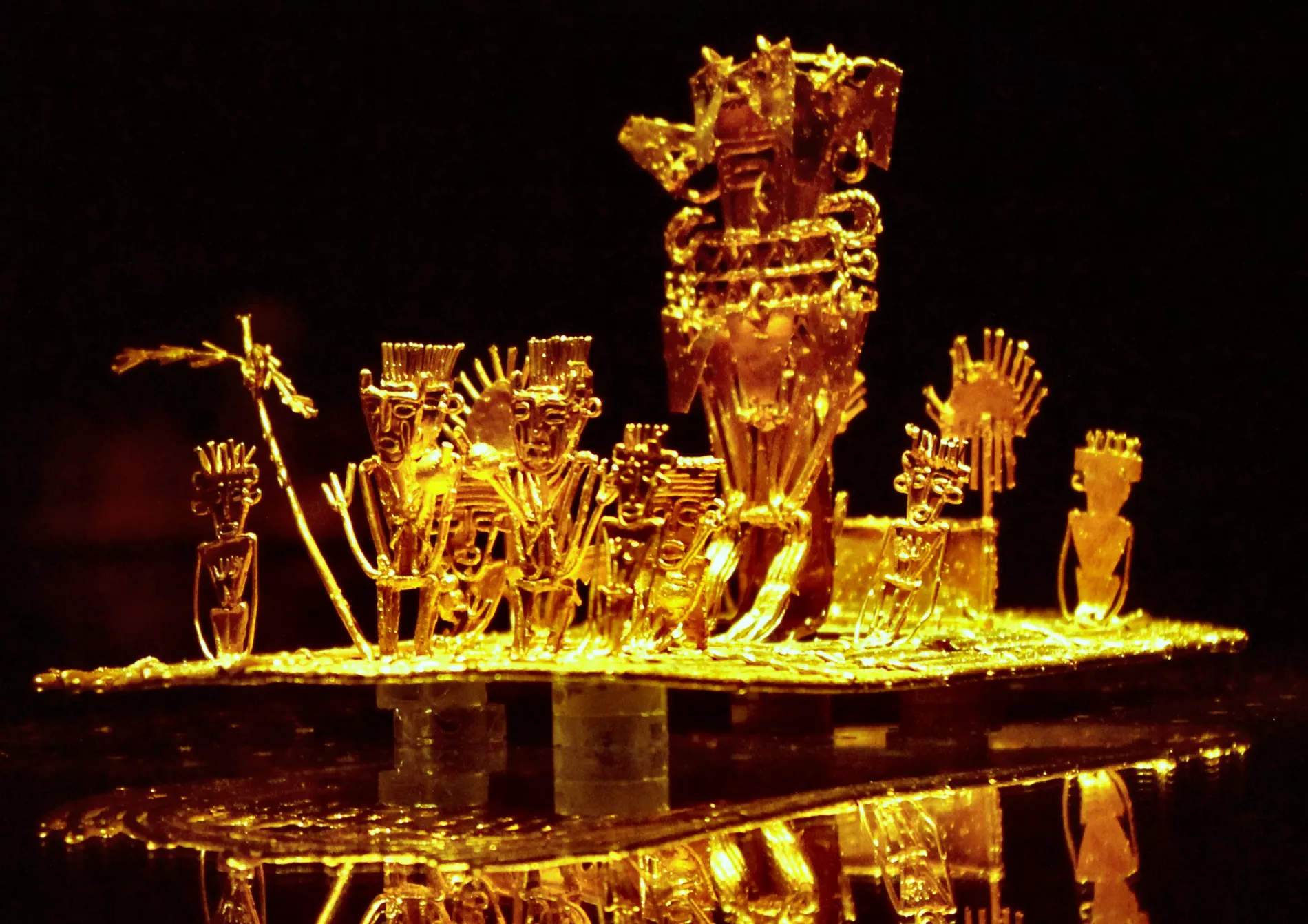
The story of Atahualpa's ransom was a catalyst, but not the source of the legend. The true origin of the myth is connected with another people — the Muisca, who lived on the Cundinamarca plateau. According to chronicles written by the poet and conquistador Juan de Castellanos in the 1570s, the Muisca had an amazing ritual for inaugurating a new ruler. Long before the arrival of the Spaniards, the future chief was brought to the sacred Lake Guatavita. His body was rubbed with aromatic oils and resins, and then covered from head to toe with gold dust. In the rays of the rising sun, he truly became the "golden man" — El Dorado. On a raft loaded with gold ornaments and emeralds, he would sail to the middle of the lake.
Divine Dust and the Sacrificial Ritual
The ceremony on the lake had a deep sacred meaning. Upon reaching the center of the water body, the chief would throw all the brought treasures into the water, offering them as a gift to the goddess Fúratena. The legend itself says that the goddess dwelt in the depths of the lake and demanded offerings. After the gold and emeralds disappeared into the water, the ruler himself would jump into the lake. It was believed that if the gold dust was completely washed from his body, it meant the goddess had accepted the sacrifice and was favorable to the new chief. It was this custom, heard by the Spaniards from the local Indians, that gave rise to a true fever. The Europeans logically assumed that since gold had been thrown into the lake for centuries, countless treasures must lie at the bottom.
Срочная продажа

- 90m2
- 3
- 2
 Calpe, Spain

- 60m2
- 2
- 2
Calpe, Spain

- 150m2
- 2
- 2
Marbella, Spain

- 87m2
- 3
- 2
Estepona, Spain
- 75m2
- 2
- 3
Alicante, Spain

- 72m2
- 3
- 2
- 2
Alicante, Spain
 Lloret de Mar, Spain

- 491m2
- 4
- 5
Benidorm, Spain
The Hunt for Treasures and Geographical Discoveries
Draining the Lake: Four Centuries of Fruitless Attempts
The news of the golden bottom of Lake Guatavita spurred the Spaniards to action. Already in the mid-16th century, they ordered the Indians to bail out the water using whatever means were at hand — literally leather scoops and gourd bottles. Of course, the water level hardly changed. In the 17th century, technology advanced: the conquistadors decided to dig a trench in the lake's crater to divert the water. They managed to lower the level slightly, and a few golden figurines appeared, which only whetted their appetite. But the walls of the trench collapsed, burying their hopes. In the 19th century, British investors got involved with steam engines. They managed to drain the lake down to the mud level, but the sun quickly turned the mud to stone. A few more artifacts were found at a depth of several meters, but the main treasures remained out of reach.
Searching at Random Across the Continent
While some treasure hunters methodically tried to drain Lake Guatavita, others ventured into the depths of the continent. The Spaniards, interrogating captured Indians, constantly heard stories that after the death of a leader, his people would go to the most remote places and build a new golden city there. These tales acted like a drug. The most famous expedition started in February 1541 from Quito, led by Gonzalo Pizarro. A detachment of several hundred conquistadors and thousands of Indian bearers plunged into the jungle. They found nothing but hunger, disease, and hostile tribes. When Francisco de Orellana, sent to find food, didn't return, and instead discovered the Amazon River, the expedition essentially failed. But the stories of the survivors continually fueled the legend.
The Architecture of El Dorado: What the Conquistadors Sought
It's important to understand that the Europeans weren't just looking for a pile of gold items. They were searching for a city with a specific architecture, similar to those they had seen among the Aztecs or Incas. Their imaginations conjured up temples with golden roofs, palaces with walls encrusted with emeralds, and market squares where jewels were used as common currency. This was also fueled by the Indians' stories that deep in the jungle, there existed settlements where gold was so abundant that it was used to make fishing hooks and household utensils. In the 20th century, the Polish traveler Jacek Pałkiewicz organized an expedition based on rock carvings found in Peru. He allegedly managed to find the ruins of an ancient city, beneath which lay an underground city. However, no convincing evidence was provided.

El Dorado Today: Tourism, Culture, and Practical Information
How to Get to Lake Guatavita in 2026
Today, any traveler can touch the mystery of El Dorado. Lake Guatavita is the main attraction open to tourists. The nearest major airport is El Dorado in Bogotá (airport code BOG), which is one of South America's main hubs. From there, you can reach the lake in two ways. The first is to rent a car and drive yourself northeast along the highway; the travel time is about two hours. The second, more popular option is to book an organized tour. In 2026, group tours from Bogotá to Lake Guatavita depart daily. The average cost of the excursion is around 99 US dollars per person. This price typically includes transportation, the services of a professional guide, and entrance tickets to the national park.
What to See: Architecture and Nature
The path to the lake begins with a light trek through the national park. The ascent takes about an hour and includes climbing 152 steps carved directly into the crater slope. The lake itself has an almost perfectly round shape, and the surrounding misty forests create a mystical atmosphere. In addition to the lake, it is definitely worth visiting the small town of Guatavita, located at the foot of the mountain. It is an example of colonial architecture: white houses with tiled roofs and cobblestone streets. The town itself was moved to a new location in the 1960s but has retained its authentic spirit. Combined tours from Bogotá are also popular, pairing a visit to the lake with the Salt Cathedral in Zipaquirá — a unique underground church carved into the rock at a depth of 180 meters.
Local Currency, Districts, and Cost of Living
If you plan to stay longer in Colombia, it's useful to know about the local currency — the Colombian Peso (COP). The exchange rate in 2026 remains stable, making the country affordable for tourists. Lunch at an inexpensive restaurant in Bogotá will cost around 10–15 dollars. Regarding real estate, the districts of the capital vary greatly in status. The most expensive and prestigious areas for living and buying property are Chapinero and Usaquén in northern Bogotá. They are home to upscale restaurants, boutiques, and business infrastructure. More affordable options can be found in the Techo district and partly in the historic center of La Candelaria, although the latter is more tourist-oriented, with many hostels and guesthouses.
What's Happening in Colombia in 2026
Colombia's tourism industry continues to develop actively in 2026. The country's authorities are paying special attention to preserving cultural heritage. New eco-trails and interpretation centers dedicated to the Muisca culture are opening in the vicinity of Bogotá. Experts advise booking excursions to Lake Guatavita in advance, especially during peak seasons (December-January and June-July), as the number of tourists is growing every year. For those seeking a deeper immersion, multi-day tours are organized following the routes of the conquistador expeditions, including visits to remote areas of the Andes and the Amazon basin. The prices for such expeditions range from 500 to 2000 dollars, depending on the duration and complexity of the route.
Conclusion: Is the Door to El Dorado Open?
The legend of El Dorado has traveled the path from a specific ritual on a lake to a large-scale myth that changed the history of an entire continent. The golden city itself will most likely remain a beautiful legend. But the door to the mystery remains slightly ajar. Lake Guatavita keeps its secrets at the bottom, and the jungles of Colombia, Peru, and Ecuador hide the ruins of ancient civilizations, many of which have not yet been discovered by archaeologists. In 2026, everyone has the opportunity to follow in the footsteps of the conquistadors, to see with their own eyes the place where this great story was born, and perhaps make their own discovery.